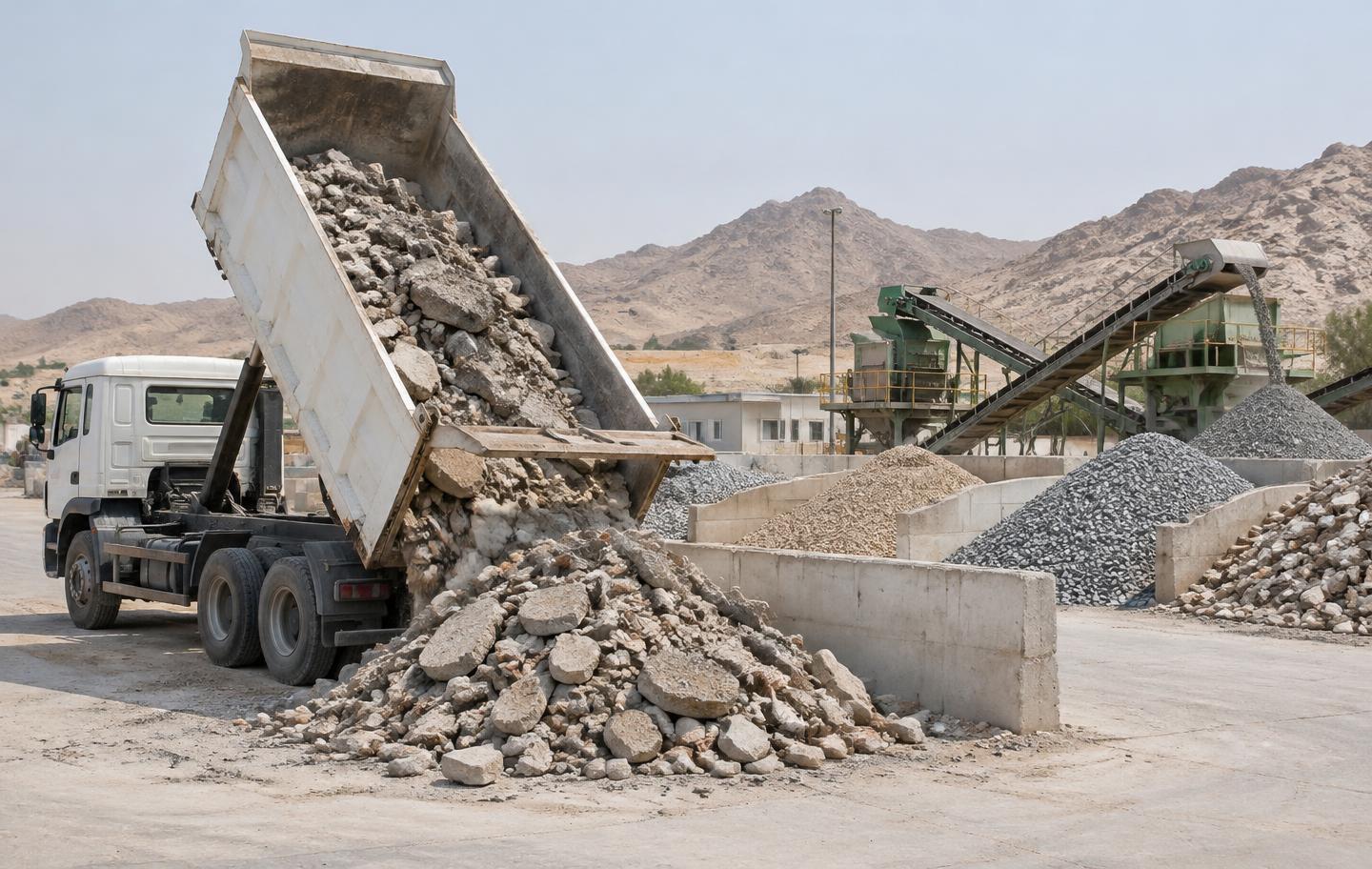
Managing construction and demolition (C&D) waste is an essential part of project management and environmental protection. A sound approach starts with identifying the waste, selecting a suitable service provider, monitoring its movement and retaining evidence of receipt at the designated destination.
A news report published on 5 November 2026 described a joint inspection campaign by Riyadh Municipality, the National Center for Waste Management (MWAN) and the Riyadh Region Emirate. The campaign identified approximately 100 violations across several authorities’ jurisdictions. Inspectors also checked transporter licensing and delivery of C&D waste to approved sites. The report highlights the importance of following waste through to its destination, beyond clearing it from the project site. [1]
1. Identify the Waste Before Requesting a Quote
Prepare a description covering waste types, estimated quantities, project location, work duration and collection frequency. This helps providers select suitable containers and vehicles and prepare clearer quotations.
If potentially hazardous materials are identified, such as asbestos-containing materials or chemically contaminated waste, seek specialist assessment to determine their classification and handling requirements. Hazardous classification depends on the waste’s characteristics; materials from the same site should not automatically be assigned the same classification. [2]
2. Check the Transporter’s Licence and Authorised Activities
Before signing a contract, check that the provider’s licence is valid and that its authorised activities and waste types cover the proposed service. Use MWAN’s official channels for verification or enquiries.
MWAN’s waste transportation technical guidelines emphasise engaging licensed providers and using the waste transport document as required. [3]
3. Agree on the Destination Before Collection
Ask the provider to identify the receiving facility or site, and confirm its suitability for the waste and the requirements applicable to your project. It is good practice to record the destination and responsibility for providing receipt documentation in the service scope.
For clearer contracting, a quotation should specify:
- Waste types and estimated quantities.
- Container numbers, capacities and collection frequency.
- Pricing basis and included charges.
- Destination and documents to be supplied.
- Arrangements for additional quantities or rejected deliveries.
These are recommended contract-management measures to clarify expectations and reduce disputes.
4. Retain Transport and Receipt Records
Saudi requirements for construction, demolition and renovation waste include provisions on licensed transporters and receipt documentation, according to the permit type and the responsibilities assigned to the relevant parties. [4]
For practical oversight, maintain a project file containing the contract, licensing details, transport documents, receipt records and any available or required weighbridge tickets. Confirm your project’s documentation requirements with the supervising engineering office. A commercial invoice alone does not necessarily establish where the waste was delivered.
5. Compare the Full Service Scope
Compare quotations using consistent quantities, collection frequencies, destinations and documentation requirements. Prices may differ because loading, transport and receiving-site charges are included differently.
Through Beati, you can request quotations for waste collection and transportation and compare service scope and cost, while checking that the provider’s licence is suitable for your project.
Sources
- [1] Riyadh Municipality and MWAN inspection campaign — Sabq, 5 November 2026 (in Arabic) (opens in a new tab)
- [2] Waste Management Law Implementing Regulations — MWAN, Articles 49 and 50 (in Arabic) (opens in a new tab)
- [3] Waste transportation technical guidelines — MWAN (in Arabic) (opens in a new tab)
- [4] Construction, demolition and renovation waste disposal requirements — coverage published by MEWA, 27 July 2024 (in Arabic) (opens in a new tab)
Submit your request and compare quotations before choosing
Request provider quotations(opens in a new tab)